grazerkunstverein
(gathering)
Ways of Telling
Gareth Bell-Jones, Vaari Claffey, Mark O’Gorman, Elisabeth Molin, Aapo Nikkanen, Sean Lynch, Sam Keogh, Frank Wasser
December 11, 2026. 12am–6pm
Drawing on Ireland’s longstanding oral traditions, Ways of Telling approaches storytelling as both a result and a means of artistic practice. Against a backdrop of contracting cultural budgets, the gathering takes on renewed significance. The programme draws attention to how artists produce, complicate and circulate knowledge, and how their practices establish connections between people, places and histories. Rather than offering an instrumental defence of the arts, the event takes the form of a show-and-tell, moving between folklore, personal correspondence, archival material, hypnosis and speculation.
This program is put together by Yana Foqué and Frank Wasser. It builds on relationships established through Frank Wasser’s current Artist Placement at Grazer Kunstverein, transforming an individual opportunity into a wider platform for artists and their methodologies. Different from the original concept behind the London-based Artist Placement Group, the model at Grazer Kunstverein embeds an artist within the operational structure of the institution for an extended period, repositioning artistic thinking back at the core of institutional practice instead of solely its exhibition spaces. The artist placement centres how artists can help determine the ways in which art institutions think, organise and produce culture. Wasser’s long-standing insider–outsider perspective and critical engagement with institutional systems make his practice particularly suited to inaugurate this initiative.
Program
12:00–12:10 — Arrival and welcome
12:10–12:20 — Welcome words Frank Wasser and Yana Foqué
12:20–13:00 — The Artist Placement Group, Keynote, Gareth Bell Jones
An introduction to the pioneering work of the Artist Placement Group (APG), founded in Britain in 1966, and its radical proposition for placing artists in industrial, commercial and governmental contexts. APG challenged conventional understandings of artistic practice, authorship and the relationship between art and the wider world. Revisiting its history, key ideas and working methods, the lecture explores the group’s enduring relevance.
13:00–13:40 —A Murmur, Repeated, Artist talk, Sean Lynch
Sean Lynch will try to speak to some of his current research into public art in Ireland, and the narratives, folklore and potentials for mischief. The presentation will feature stories about stone carving, some conceptual art stuff in the 1990s, and work by the artist Martin Folan (1955–2014) who collaborated with the Traveller community of Limerick, realising artworks that addressed the inherent racism towards indigenous ethnic communities in Ireland.
13:40–13:50 — Ten minutes break
13:50–14:30 — FOX SLEEP, Reading, Elisabeth Molin
Drawing on her book FOX SLEEP (2026), Molin will read a series of bedtime stories where perspectives blur between the narrator, a camera, monsters and the medical gaze. The stories relate to how capitalism embeds itself psychologically. Here houses become protagonists, ghosts become property owners, screens start to bleed, and language glides in a slippery zone between wakefulness and dreams.
14:30–15:10—Artist-talk, Aapo Nikkanen
Aapo Nikkanen is an artist, researcher, and hypnotherapist. During his presentation, Aapo will tell stories he’s written and stories he’s collected from hypnotherapy literature, including some he’s used in his performances. They draw on the Ericksonian tradition of using metaphor to invite listeners to see things from a different perspective. Though rooted in hypnotherapy, these stories stand on their own as imaginative and often surprising pieces of storytelling.
15:10–15:50: Coffee/Tea
15:50–16:30: Dog Whistles and Easter Eggs, Artist Talk, Vaari Claffey
In Dog Whistles and Easter Eggs, Vaari Claffey explores the forms of working knowledge that emerge between people, animals and machines, relationships often grounded in acceptance and familiarity rather than complete understanding. Her presentation brings together found artefacts, archival teaching slides and other material elements to explore the unlikely connections through which knowledge and stories are formed. Her wider practice involves working closely with artists to develop experiential projects across a range of media, often drawing on forms of hosting and gathering to examine how people come together and what kinds of social relations and exchanges these encounters make possible.
16:30–17:00 Informalities, Performance, Mark O’Gorman. Frank Wasser
Building on a year-long dialogue around their respective practices and work conducted primarily through WhatsApp voice notes, O’Gorman and Wasser have, in the one-month lead-up to this gathering, exchanged one time-stamped text a day. Written between work and life commitments, these exchanges reflect on lived and working conditions, memories and recollections, taking on a psychoanalytical quality while remaining unrestricted in subject and form. With a shared writing practice providing the impetus, the exchange draws on friendship as a space for thinking alongside one another, making associations and developing methodologies through navigating institutions. For this gathering, they will aim to bring this ongoing correspondence into a performative work.
17:00-17:10: Ten minute Break
17:10–17:30 — Doppelsöldner, Performance, Sam Keogh
Doppelsöldner (2026) is an extrapolated combination of two seemingly distinct characters; a 16th century Landsknecht, and a centre-right politician/self-employed businessman from present day Ireland. Through performance, props, drawing and costume, Keogh traces the development of the contemporary bourgeois subject from one of its beginnings – a bloody field in Frankenhausen scattered with the vanquished corpses of peasants. The Battle of Frankenhausen, fought on 15 May 1525 near the town of Frankenhausen in Thuringia, was one of most decisive and bloody confrontations of the German Peasants’ War (1524–1525)
This performance is part of a larger body of work composed of large-scale paper collages which draw heavily from The Unicorn Tapestries—a series of seven sixteenth-century Flemish tapestries depicting the pursuit of a unicorn through an idealised French landscape.
Additional Credits: Costume elements: Jonty K Mellmann. Song: Avicii ‘Wake me Up’ 2013
17:20–18:00 — Closing conversation—panel talk, Q&A.
The gathering falls on the final weekend of the exhibition Martin Maloney, open through December 13.
Free of charge. No RSVP.
This project is supported by Culture Ireland.
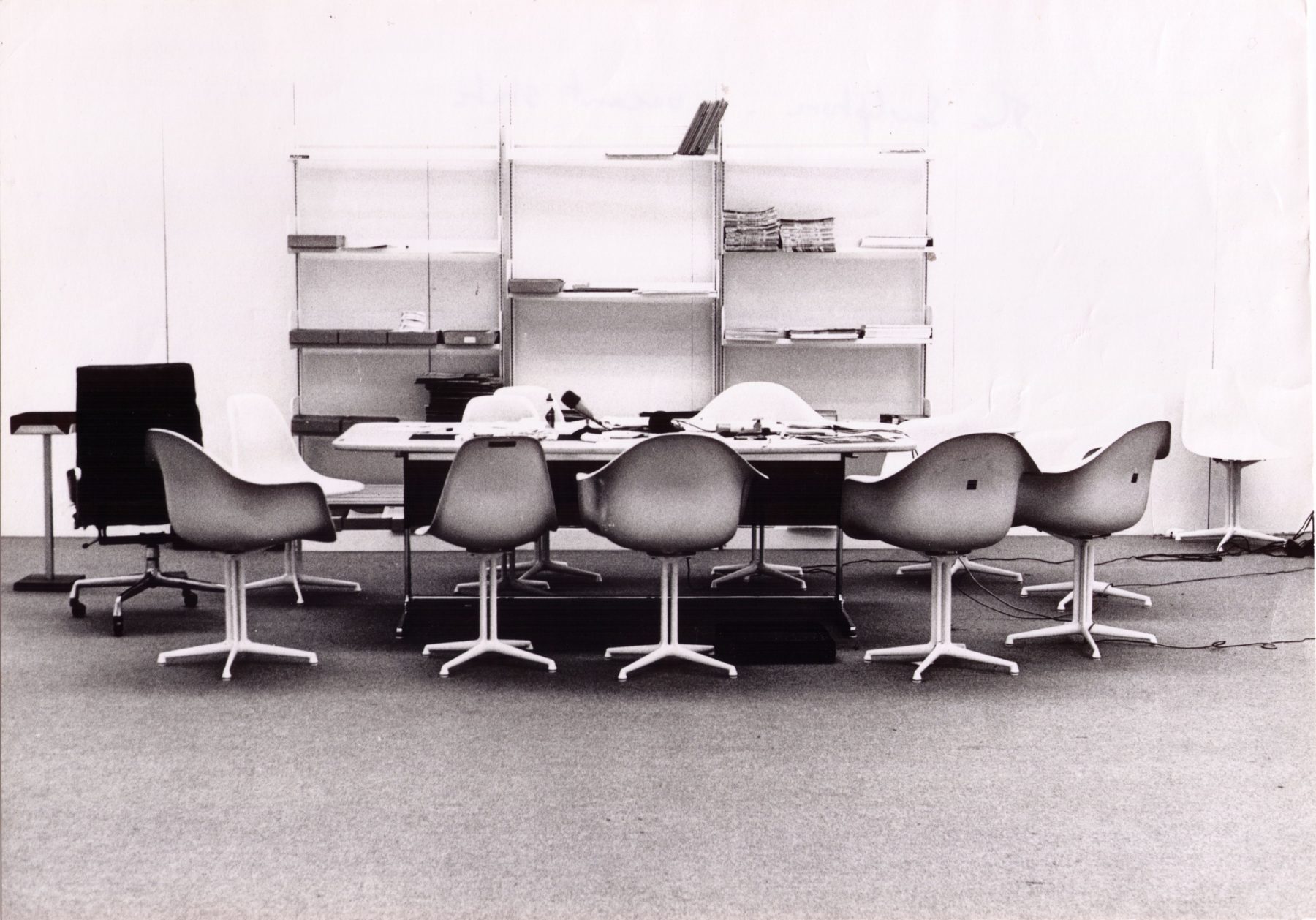
01Artist Placement Group, The Sculpture – vacant state, exhibition view Between 6, Kunsthalle Düsseldorf, 1971